Published 2026-10-06 · ICONK9, Nokesville, Virginia
The short answer
For most families looking for a family protection dog, a well-bred, well-evaluated German Shepherd is the more forgiving choice, and a Malinois is the right choice only for a smaller group of households that can live with what the breed needs every single day. That is the general picture. It is not the decision. The German Shepherd vs Malinois question is usually asked as if the breed settles it, when the thing that actually decides a family guardian's success is the individual dog's temperament, the household it lands in, and the handler who will run it for the next ten years.
This guide is written for families in Northern Virginia, Washington DC and Maryland who are weighing the two breeds for a guardian role. It is deliberately not a list of breed superlatives. Protection-dog marketing tends to sell the Malinois as the elite option and the Shepherd as the safe one; both descriptions hide more than they explain.
What a family guardian actually has to do
Start with the job, not the breed. A family guardian spends almost all of its life not protecting anyone. It lives in a kitchen, rides in a car, meets the children's friends, ignores delivery drivers, settles while the family has dinner guests and stays neutral at the vet. The protective part of its job is a small fraction of its time, and it only has value if the rest of the time is calm and predictable.
That is why we separate a family guardian from a working protection dog. The difference, and why it matters for liability and daily life, is covered in family guardian vs. protection dog. In short: a guardian needs clear thinking, stable nerves, an off switch and social neutrality first, and controlled protective behavior second. A dog that is spectacular on a bite sleeve and cannot relax in a living room is the wrong dog for a family, whatever its breed.
Where the two breeds tend to differ
These are tendencies, not guarantees. Both breeds include a wide range of temperaments, and working-line and show-line dogs within the same breed can be very different animals.
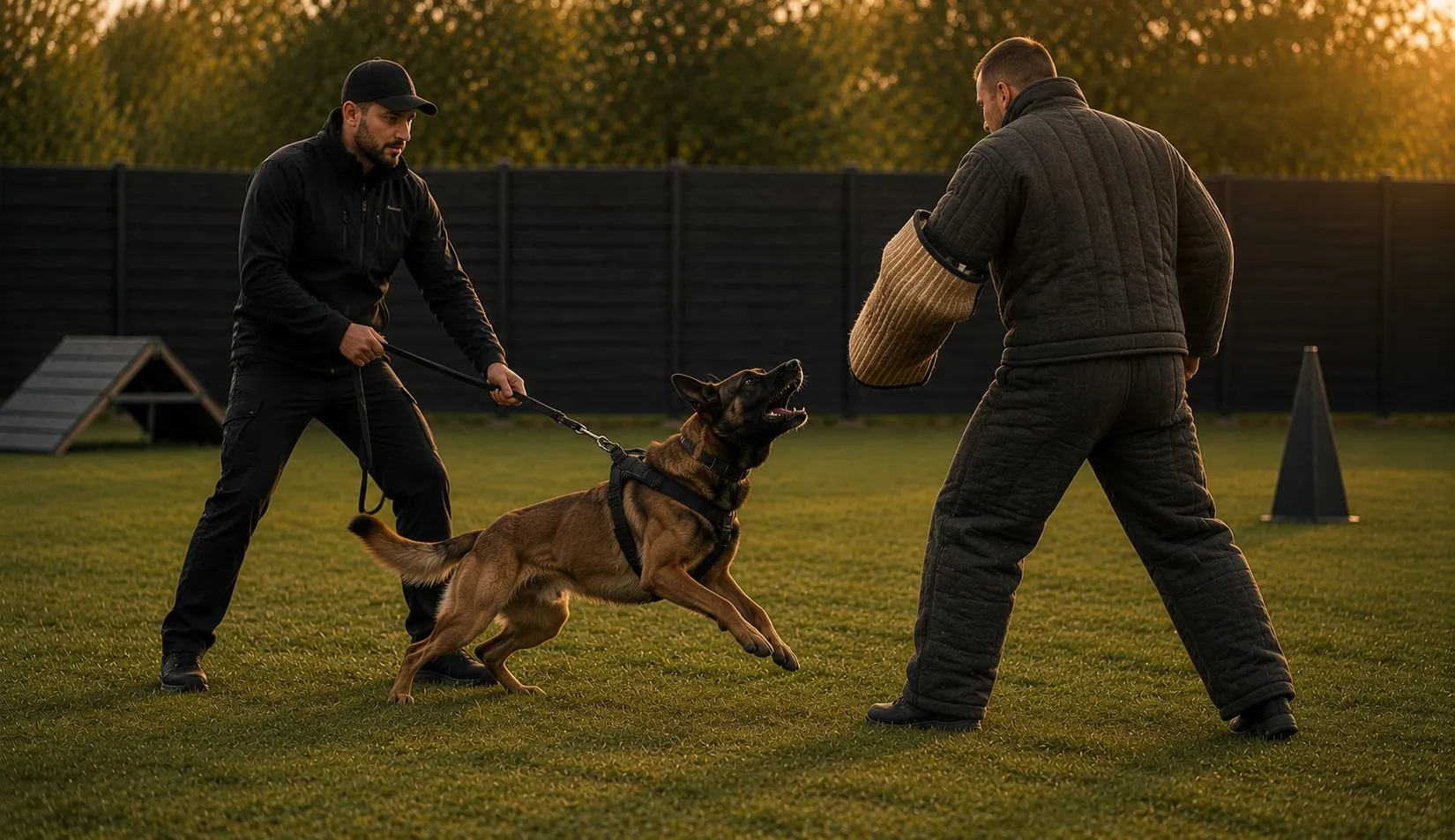
Intensity and arousal. Malinois are generally faster to switch on, run at a higher baseline of energy and can be more reactive to movement and sound. In the right hands that is exactly what makes them excellent working dogs. In a busy family home it can mean a dog that is constantly looking for a job and makes one up when it is not given one.
Recovery and the off switch. What matters for a family is not how quickly a dog turns on, but how quickly it comes back down. Plenty of German Shepherds and plenty of Malinois have a good off switch; plenty of both do not. This is one of the first things an evaluation measures, because it predicts daily life far better than breed reputation does.
Handler demand. A Malinois usually gives less margin for inconsistent handling. Small mistakes in timing, routine or boundaries tend to show up faster and bigger. A Shepherd is often, though not always, more tolerant of the ordinary imperfections of family life: different people giving commands, a busy week, a missed training session.
Exercise and mental work. Both breeds need real daily structure. The Malinois typically needs more of it, and it needs to be work, not just a walk. A family that can genuinely commit time every day is in a different position from a family that intends to.
Physical presence. Shepherds are usually heavier and coated; Malinois are leaner and lighter. Deterrence is often mentioned here, but for a family guardian the dog's behavior at the door does more than its silhouette.
Why the individual dog matters more than the breed
Choosing on breed alone is how families end up with a Shepherd that is nervy and fear-driven, or a Malinois that is too much dog for the house. Nerve strength, social behavior with strangers and children, environmental stability, possessiveness, and the way a dog handles pressure all vary within each breed. Two dogs with identical pedigrees can need completely different programs.
A fear-driven dog that barks and lunges at the door is not protective; it is insecure, and it is the most common liability in households that wanted a guardian. Real protective ability comes from a confident dog that is not worried by the world and therefore does not need to react to every part of it. That confidence is a temperament trait you select for and test for. It is not something training can bolt onto an unstable dog afterwards.
Questions that decide which breed fits your household
Who will handle the dog day to day? If the answer is "everyone," the household needs a dog that tolerates several handlers of different skill levels. That generally points away from a high-intensity Malinois.
Are there young children? Children run, shout, fall over and wave things. A dog with a strong prey response to movement needs management that a busy household may not be able to sustain. Social stability with children is tested, not assumed.
What does a normal week look like? Travel, long workdays, staff in and out of the house, frequent guests and contractors all change what the dog has to tolerate. A guardian has to accept invited people as calmly as it alerts to uninvited ones.
What experience does the primary handler have? Prior experience with a confident working-breed dog changes the answer. So does willingness to be trained yourself; handler training is part of every guardian placement, not an optional extra.
What is the dog for? If the honest answer is mostly companionship and a reliable alert, many families do not need a protection-trained dog at all; a stable, well-trained dog with good obedience may be the better fit.
Buying a trained dog vs. training your own
There are two routes. You can source a dog that has already been selected, evaluated and trained, and then be matched with it; ICONK9's certified dogs are internationally sourced, evaluated and trained dogs matched to a family, handler or mission. Or you can start with a dog you already own or a puppy, and develop it through an evaluation-based program such as protection dog training, often delivered as board and train at the Nokesville campus.
Either route goes through the same sequence: evaluation, a program built from the test results rather than chosen from a menu, adaptation into real life and handover to the family, then follow-up. No dog is delivered before the adaptation phase, because a guardian that behaves on the training field but not in your house has not been trained for your house.
If you have not yet chosen, a dog selection consultation ($250 per hour) is the cheapest point in the process to avoid an expensive mismatch. It is also the right step if you already own a Shepherd or Malinois and want a straight answer on whether it is suitable for guardian work at all.
Cost and requirements at ICONK9
The structure is the same for every dog. The evaluation comes first and the testing fee depends on the dog: $250 for Level 1 puppies and early-stage dogs, $1,000 for Level 2 adolescent and young dogs, $2,000 for Level 3 developing and mature dogs, a custom quote for Level 4 established behavior patterns, and application-based Level 5 for severe or complex cases. Training programs after testing start from $1,000, and the final price is confirmed before training begins; stay, food, transport, veterinary needs and taxes are calculated separately when required. Campus programs require a dog at least 3 months old with complete, documented vaccinations.
Families from DC, Maryland and Northern Virginia
Most guardian clients come from the premium catchment: McLean, Great Falls, Arlington, Washington DC, Potomac, Bethesda and Chevy Chase. From those areas the drive to Nokesville is roughly 35 to 80 minutes, which is why the usual model is an evaluation visit, board and train for the core work, and adaptation and handover with the family. The full list is on our service areas page.
Next step
If you are deciding between a German Shepherd and a Malinois, or you already have one and want to know whether it can be a family guardian, request an evaluation or start with a free 15-minute intro call. ICONK9 was founded by İrşat Üner, a dog trainer with a military K9 background (retired NCO), with 26+ years of experience across 12+ countries. The recommendation you get will be about your household and your dog, not about which breed sounds more impressive.
Frequently asked questions
Is a German Shepherd or a Malinois better for family protection?
For most families a well-bred, well-evaluated German Shepherd is the more forgiving choice, because it usually tolerates several handlers and ordinary household inconsistency better. A Malinois suits households with an experienced primary handler and real daily time for structured work. The individual dog's temperament matters more than the breed, which is why ICONK9 evaluates before recommending.
Is a Belgian Malinois a good family dog?
It can be, in the right household. Malinois generally run at higher intensity and need more daily structured work and more consistent handling. In a busy home without that structure, the same drive that makes them excellent working dogs often turns into problem behavior.
Can my existing German Shepherd or Malinois become a family guardian?
Possibly. Guardian suitability depends on nerve strength, recovery after arousal, social neutrality with guests and children, and how the dog handles pressure. An evaluation answers that before any protection work begins; an unstable or fear-driven dog should not be trained for protection.
Should I buy a trained protection dog or train my own?
Both routes work and both go through evaluation, a tailored program, adaptation into your home and handover. ICONK9's certified dogs are internationally sourced, evaluated and trained dogs matched to a family; training your own dog is done through an evaluation-based program, often as board and train.
How much does family guardian training cost at ICONK9?
Testing fee by level ($250 Level 1, $1,000 Level 2, $2,000 Level 3, custom quote Level 4, application for Level 5), then training programs from $1,000 with the final price confirmed before training begins. Stay, food, transport, veterinary needs and taxes are separate when required; a dog selection consultation is $250 per hour.
Do you work with families in DC, Potomac and McLean?
Yes. Families from McLean, Great Falls, Arlington, Washington DC, Potomac, Bethesda and Chevy Chase drive roughly 35 to 80 minutes to the Nokesville, Virginia campus for the evaluation and handover, with board and train covering the core work.