Insights
When to Call a Professional vs. DIY Training at Home
Most everyday training is fine to do yourself. A few specific warning signs mean it's time to stop guessing.

Most everyday training is fine to do yourself. A few specific warning signs mean it's time to stop guessing.
Most basic obedience — sit, down, loose-leash walking, house manners — is genuinely learnable at home with consistency and the right information, and there's no need to outsource it. The harder question is knowing where that line ends, because waiting too long on the wrong kind of problem tends to make it worse, not better.
Slow but steady progress, a puppy or young dog with no history of aggression, isolated issues like jumping or mild leash pulling, and an owner who can stay calm and consistent — these are all reasonable to keep working on independently, ideally with good structured information rather than conflicting advice from five different sources.
Any bite, or a dog that has gone still, stiff, and silent before reacting (a more dangerous pattern than a dog that growls first); resource guarding that's escalating rather than improving; fear or reactivity that's getting broader over time instead of narrower; a training plan that's been consistently applied for several weeks with no improvement at all; or an owner who's starting to feel afraid of their own dog. Any one of these is a reasonable trigger to stop experimenting and get a professional assessment.
Past a certain point, the problem usually isn't a lack of owner effort — it's a lack of an accurate read on what's actually driving the behavior. Applying more of a technique that was never addressing the real cause doesn't just fail to help; it can teach the dog that escalation is necessary to be heard, making the eventual professional intervention harder than if it had happened earlier.
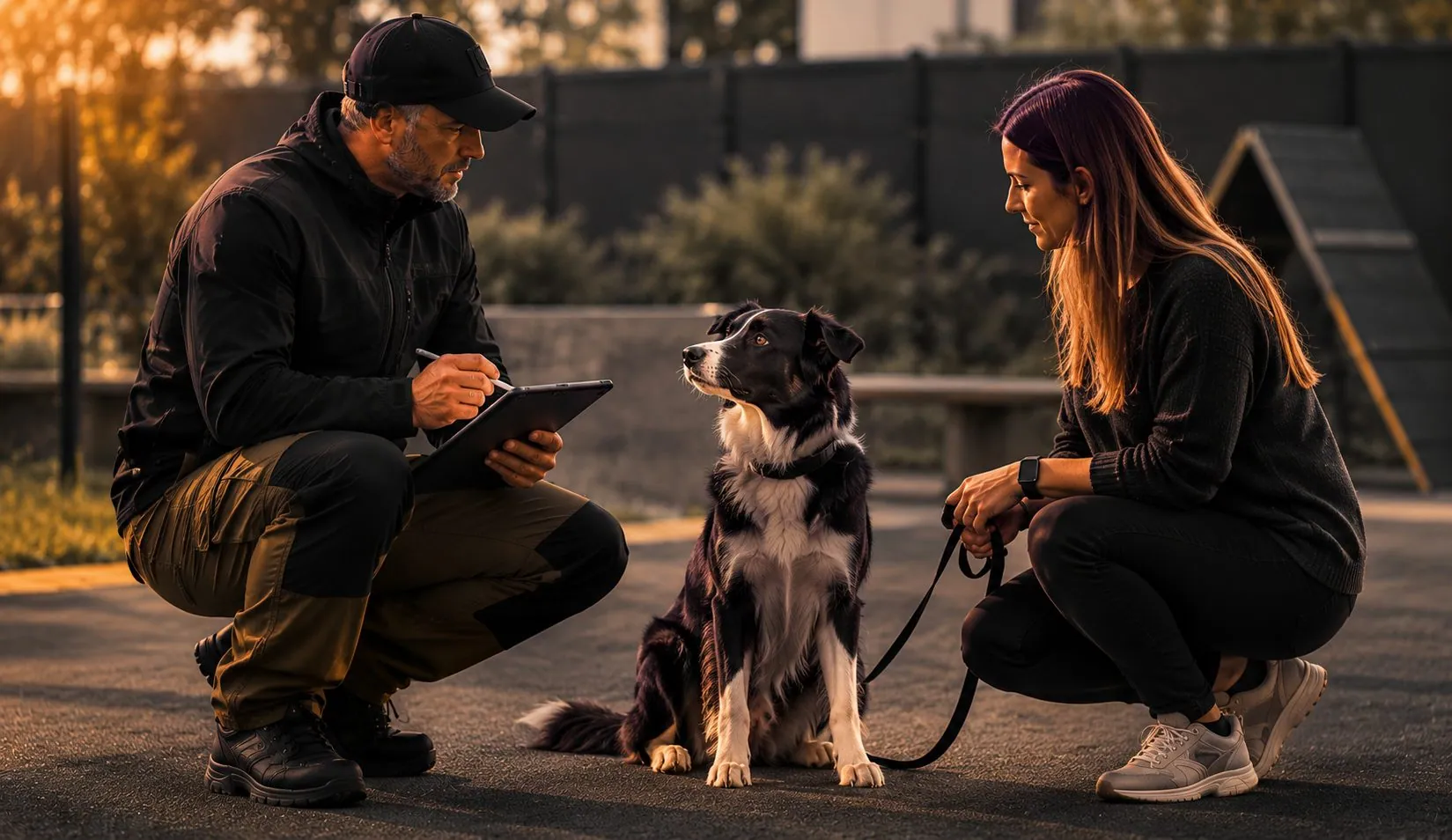
A professional evaluation isn't just "more experienced hands doing the same thing" — it's a structured read of the dog's temperament, drives, history, and the family's specific environment, producing a plan built for that dog rather than a generic protocol. That diagnostic step is usually the actual gap, not raw training technique.
This is the entire reason our process starts with evaluation and consulting rather than a fixed class schedule — so a family gets an honest answer about whether they're looking at a normal training curve or a problem that needs a structured, professional plan, before more time gets spent guessing.