Insights · Security Teams
K9 Handler Training for Security Teams: What a Real Program Covers
A security K9 is a team, not a dog. How to select handlers, what the course should teach, and how to keep the team reliable after the first shift.

A security K9 is a team, not a dog. How to select handlers, what the course should teach, and how to keep the team reliable after the first shift.
K9 handler training for security teams is the part of a canine program that decides whether the dog is ever used well. A security team can buy or develop an excellent detection or patrol dog and still end up with an unreliable capability, because the person on the other end of the leash was never trained to read, manage and direct that dog under pressure. A real program evaluates the dog, the handler and the mission together, trains the handler alongside the dog rather than separately, practices in the environments the team will actually work, and defines maintenance before the first shift.
This guide is written for security managers, corporate and private security teams, and organizations starting or rebuilding a dog unit. It explains how ICONK9 approaches canine handler training and what you should expect from any provider. Police, military and government units will find the agency-specific version on our Police & Government K9 programs page.
In ICONK9's handler system, the handler is the driver of the system. The dog does not work in a vacuum: it reads the handler's posture, timing, tension and decisions all day long. A handler who is late with a reward, inconsistent with a command or anxious in a crowd is training the dog every minute, whether anyone intends it or not. Over weeks, that drift shows up as a dog that searches less carefully, alerts less clearly, or becomes harder to control around the public.
For a security team this is not an abstract point. Your dog works around employees, visitors, contractors, vehicles and members of the public. Every one of those encounters depends on the handler's judgment: when to work, when to hold, when to create distance, and when to take the dog out of a situation entirely. A well-trained dog with an untrained handler is an untrained team.
Every ICONK9 engagement starts with an evaluation, and security work is no exception. Before a course is designed, three questions are answered.
What is the mission? Detection at an access point, patrol of a perimeter, a visible deterrent presence, or a mix. The mission defines the environments, the hours, the level of public contact and the skills the team must hold. A course built for the wrong mission profile produces confident handlers who are confident about the wrong things.
Which dogs will the team work? If the team already has dogs, they are evaluated for temperament, drives, environmental stability, social behavior around people who are not threats, health and training level. If the team needs dogs, ICONK9 sources dogs internationally and reviews suitability, temperament, health and training potential before recommending a dog for a mission profile; see certified dogs. If a dog is not suitable for the role, the answer is no.
Who will handle? Handler selection is often skipped, and it is one of the most expensive omissions a program can make. A good handler candidate is calm under pressure, physically able to do the work, consistent in routine, willing to be corrected, and genuinely interested in the dog's daily care. The evaluation looks at the handler and at the interaction between handler and dog, because some pairings work and some do not.
ICONK9's dog handler training is built from the evaluation, not chosen from a menu, but the core areas are consistent. Use this list to check any program you are considering.
Equipment and safety. Correct fitting and use of collars, harnesses and leads, safe handling around the public, and the procedures that keep the handler, the dog and bystanders safe when something unexpected happens.
Understanding the K9 mind. How the dog perceives its environment, what drives it, how stress shows up in body language, and how the handler's own behavior changes the dog's behavior. Handlers who can read early stress signals prevent problems instead of reacting to them.
Health and first-aid awareness. Recognizing heat stress, injury and illness early, knowing what to do before veterinary care is reached, and building health checks into the daily routine.
Daily management, kennel and transport. Feeding, rest, exercise, kennel routine and vehicle transport are where reliability is built or lost. A dog that is poorly rested or inconsistently managed will not work consistently.
Handling mechanics. Leash handling, positioning, timing of commands and rewards, and clean transitions between working and non-working states.
Operational control. Directing the dog in the actual working environment: starting and stopping work on command, maintaining control around people and distractions, and making sound decisions about when the dog should not be deployed.
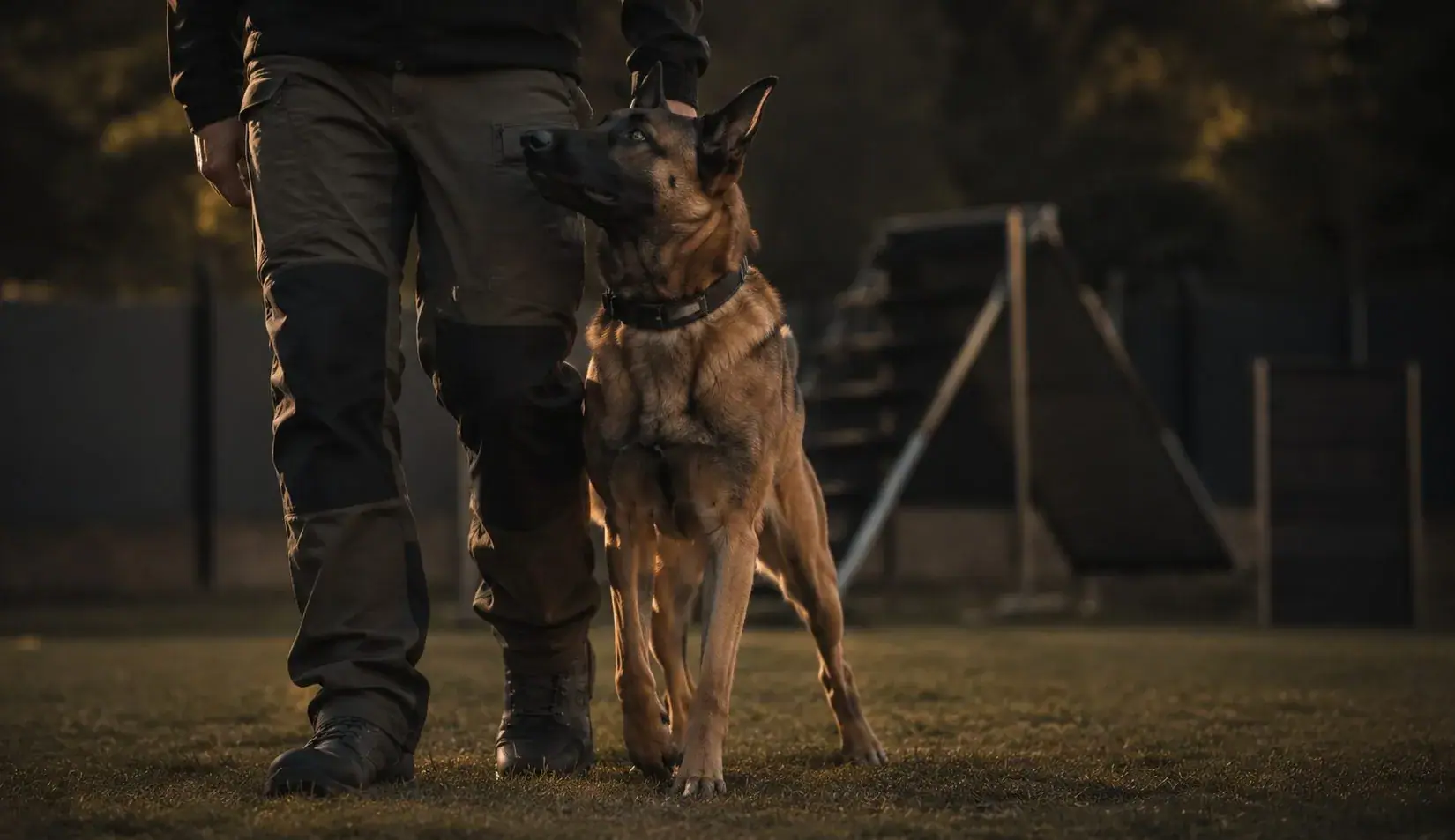
A common mistake is to train the dog first and then hand it over with a short orientation. In ICONK9's system the dog is not trained separately; the handler is trained alongside the dog, with continuous feedback, evaluation and refinement. The team learns together, and the trainer corrects the handler as often as the dog.
Training is scenario-based from the beginning. Noise, crowding, unfamiliar layouts, vehicles, slick floors, stairs, darkness and real stress are introduced deliberately, because a team that has only practiced in ideal conditions hesitates when reliability matters most. For detection teams, that means search patterns and alert behavior in the kinds of spaces the team will actually cover; see detection dog training. For patrol and deterrence roles, it means control around people and in unpredictable settings; see patrol and tactical K9 training.
When a dog needs foundation work before the team course — obedience, environmental confidence or behavior issues — that work can be done as residential training at the Nokesville campus. Our board and train program follows the same rule as everything else: the evaluation sets the program, and the program sets the duration.
A team that performs at the training campus has not yet proven it can perform at your site. ICONK9's system ends with adaptation: the dog and handler are moved into the real operating environment, the routines are tested there, and problems that only appear on site are solved there. No team is handed over before this phase. It is the same principle ICONK9 applies to every dog, from a family pet to a working dog: training is only complete when it works in real life.
Working skills decay without maintenance, and handler habits drift. A security program should define, before the first shift, how the team will stay reliable: maintenance training cadence, periodic re-evaluation of the dog and handler, refresher blocks, and a clear process when a handler changes jobs or a dog is retired. ICONK9 builds long-term follow-up into every program because the moment a team is left alone is the moment small problems start to compound.
Most failures follow the same pattern. Buying a dog before deciding who will handle it. Assigning a handler because they volunteered, not because they were evaluated. Training the dog and the handler separately. Practicing only in a quiet training area. Treating a course completion or certification as the finish line rather than a checkpoint. Budgeting for the dog but not for the handler's time and the program's maintenance. Each of these produces the same result a year later: a dog that is either not used, or used in a way that creates risk for the organization.
The fix is not complicated. Evaluate the mission, the dogs and the handlers together; train the handler with the dog in the environments the team will work; adapt the team on site; and define sustainment from day one. Our guide to what an agency should evaluate before buying a K9 covers the same logic from the procurement side.
ICONK9 was founded by İrşat Üner, a dog trainer with a military K9 background (retired NCO), with 26+ years of experience across 12+ countries. The working dog programs cover detection, protection, patrol and tactical work, tracking and dual-purpose K9 development, and handler training is part of every working dog placement rather than an optional extra. The approach is evaluation-first: no fixed packages, no course chosen from a catalog, and no case accepted just to make a sale.
Security, police, military and government programs are not limited by region. Teams train at the ICONK9 Training Campus in Nokesville, Virginia, and structured training blocks at your location can be arranged after the initial evaluation.
It starts with a capability brief: your organization, the mission profile, the sites, and any dogs and handlers you already have. Then comes the evaluation of dogs, handlers and their interaction, at the campus or on site by arrangement. A written program and price follow, confirmed before training begins. Consulting is $250 per hour; team programs are quoted after evaluation. If you are still deciding whether a canine capability is right for your organization at all, a consulting session is the right first step.
Send a capability brief through the contact form or call +1 (571) 597-5959. Tell us the mission, the sites, the number of handlers and whether you already have dogs, and we will schedule the evaluation. Contact and evaluation requests are answered within 24 hours.
At ICONK9 the course is built from an evaluation of the mission, dogs and handlers. Core areas are equipment and safety, understanding the K9 mind, health and first-aid awareness, daily management, kennel and transport routine, handling mechanics and operational control, trained with the dog in real conditions.
Yes. In the ICONK9 handler system the dog is not trained separately; the handler is trained alongside the dog with continuous feedback, evaluation and refinement, followed by adaptation in the team's real operating environment.
Yes. Existing dogs are evaluated for temperament, drives, environmental stability, social behavior, health and training level, and handlers are evaluated together with the dog. The program is built from that assessment.
Teams train at the Nokesville, Virginia campus, and structured training blocks at your location can be arranged after the initial evaluation. Security, police, military and government programs are not limited by region.
ICONK9 sources dogs internationally and reviews suitability, temperament, health and training potential before recommending a dog for a mission profile. Dogs are quoted individually after the match and evaluation.
Every engagement starts with a capability brief and an evaluation; the program, its length and price are set from that assessment and confirmed in writing before training begins. Consulting is $250 per hour.